
A Difficulty of Definitions

There are several differences between a good debater and a bad debater. And by good I don’t mean ‘talented’, or even ‘practiced’. I mean a debater who is attempting to fulfil the goal of any good debate… to get at the truth.
There are several differences, but there is one that usually comes first in any good debate, and that is the question of definition.
The first thing that should happen in any good debate, the first thing that any good debater should insist on, is a definition of what they are debating. What is this ‘green energy’ thing that one side likes and the other side despises?
Strawman
And the first general rule of definitions, in a good, honest debate, is that the guy who believes the thing, defines the thing. Now, that doesn’t mean that the other side can’t challenge the definition! If the one side says “Green energy is that wonderful and inexpensive way of getting energy without any waste products…” etc etc… then the other side can, and indeed should, challenge the ‘wonderful’ and ‘inexpensive’ and ‘without waste products’ part of the ‘definition’.
But what they can’t do and remain honest is merely present a different definition and then say that that is what is being proposed. They can’t say, for example, ‘Green energy means only using energy from green plants.” Sounds good, but isn’t what is meant.
And what one especially can’t do, and remain honest, is to get your definition of a Republican from a Democrat and then run from that. Get your definition of ‘green energy’ from an Oil and Gas man. Your definition of ‘Christian’ from Christopher Hitchens.
Theonomy
So, in my discussion on theonomy, Ryan is having a difficulty of definition. His first post in our series began with this definition:
Theonomy is a theological position asserting that the Old Testament laws classified as “civil” or “judicial” by covenant theologians are binding on Christians and modern civil governments. It was popularized in the late 20th century by theologians such as Greg Bahnsen, R.J. Rushdoony, and Gary North.
I corrected him, posting an actual definition from one of the founders of theonomy, Greg Bahnsen:
Dr. Van Til taught us that “There is no alternative but that of theonomy and autonomy” (Christian-Theistic Ethics, p. 134). Every ethical decision assumes some final authority or standard, and that will either be self-law (“autonomy”) or God’s law (“theonomy”). While unbelievers consider themselves the ultimate authority in determining moral right or wrong, believers acknowledge that God alone has that position and prerogative.
The position which has come to be labeled “theonomy” today thus holds that the word of the Lord is the sole, supreme, and unchallengeable standard for the actions and attitudes of all men in all areas of life. Our obligation to keep God’s commands cannot be judged by any extra-scriptural standard, such as whether its specific requirements (when properly interpreted) are congenial to past traditions or modern feelings and practices.
When any of us come to Christ for salvation, it is with a sense of our sin and misery before God. Our very need of the Savior arises from a conviction of sin, brought home to our hearts by the Holy Spirit showing our guilt for violating God’s commandments. As Paul wrote, “I had not known sin except through the law” (Rom. 7:7). The law defines what sin is (1 John 3:4). As such the law cannot be our personal vehicle for gaining favor with God. It rather aims at Christ as our only righteousness, tutoring us that justification must be by faith in Him (Rom. 10:4; Gal. 3:24)…
By Dr. Greg Bahnsen in New Horizons (April, 1994), emphasise mine
Note that I pulled this definition of theonomy from Dr. Bahnsen, who, in Ryan’s original post, he lists as one of the founders of theonomy.
But then, in his latest post, he seems to have forgotten this exchange and posts this definition:
Theonomy is the view that the “civil” law of the Mosaic Covenant is binding on Christians and modern civil society.
Which is false. It is simply false. There can be no other word for it, it is false. As a definition of theonomy, no one believes this. That is to say, there is no one that I have ever met or heard of who says both, “I am a theonomist” and ‘I believe that the definition of theonomy is “the view that the “civil” law of the Mosaic Covenant is binding on Christians and modern civil society.” No one. It is… a strawman
Compare and Contrast
Let us examine the differences between this false definition and that of the actual theonomic definition:
‘The Mosaic Covenant’ vs the entire Word of the LORD. A few OT chapters, versus Genesis to revelation. It is true that Ryan doesn’t stick the word ‘only’ in there. He doesn’t say that theonomists believe that the only standard for modern civil law is the Mosaic Covenant… but his language implies it, and he doesn’t seem to deny it.
Whereas the theonomist is just as happy looking to Genesis, I Kings, Psalms, Proverbs, the major and minor prophets, the gospels, the writings of the apostles… as we are to those OT chapters. His definition implies a division that we do not hold.
It may be part of the definition of his theology to make a distinction between those few OT chapters and the rest of the Scriptures. But it is not a theonomic distinction. So it does not belong in a definition of theonomy.Standard vs Binding. English can be a very precise language. There are a hundred different ways to say ‘said’, and they each have their place, their implications, even their denotations. So it is important in English to not merely shift back and forth between words that might seem synonyms, but instead to use the words that proponents use, and take their connotations seriously.
And the words ‘standard’ and ‘binding’ are not even synonyms. ‘Standard’ is a noun, ‘Binding’ is a verb (they can also both be adjectives, and perhaps other parts of speech. But the normative use of ‘standard’ is as a noun, ‘binding’ is as a verb, and they are used that way in this debate.)
Thus a ‘standard’ is something that is out there, passive, that men look to. It’s old fashioned use was in battle… so that the troops of Duke Godwin knew where Duke Godwin was. In theology, a standard is a measuring stick. It is something that people use to judge their own behaviour against. Or, similarly, they use to judge others behaviour.
’Binding’, on the other hand, is a verb. It is something that some thing does. It reaches out and touches you, keeping you from doing something, or attaching you. The most famous use might be from Tolkien, “One Ring to bring them all and in the darkness bind them.”
So to say that God’s Word should serve as a ‘standard’ for our behaviour and civil code is to wave a flag and call people to look at it. To say that it is ‘binding’ gives an entirely different impression. Especially when speaking to Christians.‘Modern Civil Society’ vs ‘All men’. Ryan proposes two groups are ‘bound’ by the ‘Mosaic Covenant’… Christians and modern civil society. Theonomy says that God’s Word is the standard for all men. There is no, one, clear difference that I can see between these two groups… but they are two wildly different groups. The theonomist speaks to ‘all men’… Christians, Jews, atheists… in all areas of life… civil society, private morality, family leadership, etc. We do not claim that God’s Word is the standard only for ‘Christians and modern civil society’.
Theonomy vs Autonomy. In the larger definition Greg Bahnsen points out that the theonomist claims that there are only two choices: theonomy and autonomy. IOW he proposes that those who are not following God’s law, are making up their own. I’m not sure that anti-theonomists of Ryan’s stripe are disagreeing with that.
Which would be a good thing to say. That he accepts that man needs to be under God’s Law, he is just disagreeing on what that law is and how we determine it. But he should say it.
Shadowboxing
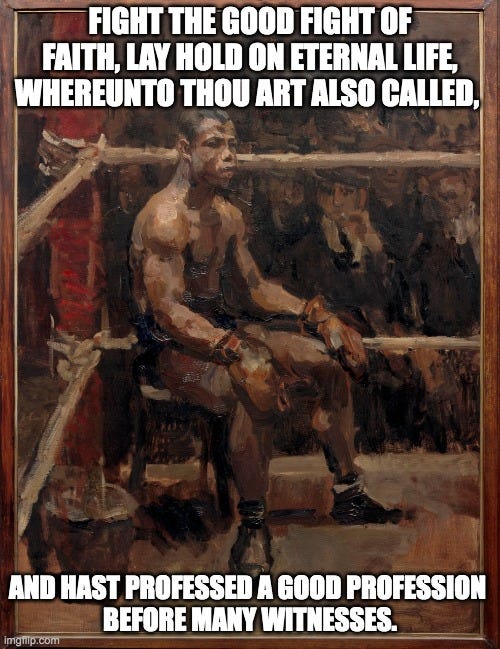
The result of putting up a false definition of something is that you might end up ‘shadowboxing’… ie punching out against where you think your opponent is, while he stands by watching with confusion. So, for example, Ryan makes a big deal about the distinction between the Mosaic code and the rest of Scripture, while the theonomist stands there wondering what the point is. Is Ryan trying to sell us his own hermeneutic? Is he denying that the New Testament is the New Covenant? Is he saying that ‘all of the Scripture except those between mid-Exodus to Joshua’ are inspired by God and profitable?
I get it. Arguing against an opponent’s actual views, and actual arguments is hard work. But Ryan states that he believes in steelmanning… and that is what steelmanning actually is. Presenting your opponents actual definition, as expressed by their best spokesmen, supported by their actual, best arguments… and disagreeing with that.
Thank you for reading Von’s Substack. I would love it if you commented! I love hearing from readers, especially critical comments. I would love to start more letter exchanges, so if there’s a subject you’re interested in, get writing and tag me!
Being ‘restacked’ and mentioned in ‘notes’ is very important for lesser-known stacks so… feel free! I’m semi-retired and write as a ministry (and for fun) so you don’t need to feel guilty you aren’t paying for anything, but if you enjoy my writing (even if you dramatically disagree with it), then restack, please! Or mention me in one of your own posts.
If I don’t write you back it is almost certain that I didn’t see it, so please feel free to comment and link to your post. Or if you just think I would be interested in your post!
If you get lost, check out my ‘Table of Contents’ which I try to keep up to date.
Thanks again, God Bless, Soli Deo gloria,
Von
Links
Ryan’s original anti-theonomic article.

Ryan’s immediate article.
God’s Word defines sin. All of God’s Word.
The Problem of Sin

In my discussion about theonomy I am dealing with the idea that all of the OT Law has been abolished… except the parts that weren’t. And the vague definition of ‘the parts that weren’t’ goes sort of under the rubric of ‘those parts repeated in the New Testament’. But the concept of ‘repeated’ is rather vague. What does it mean for a law to be ‘repeated’…
God’s Law is perfect. A fact which makes New Covenant Theology a doctrine resting on sand.
God’s Perfect Law
·
23 OCT
I am a ‘theonomist’. Now, this is not a popular position… at least not by that name. Indeed Google doesn’t even seem to know how it is to be spelled. It is probably good for me to define the term, so I will use the definition provided by one of its leading advocates, the late Dr Greg Bahnsen.
The book of Romans is filled with exegesis about how we are to relate to God’s Law: what it is good for, what it wasn’t designed for. And the entire book contradicts New Covenant Theology.
Roman Law
·
25 OCT
No, not the law that the Romans wrote and used… the word ‘law’ in the book of Romans, as written by Paul. The importance and relevance of the Law of God for modern Christians is a hugely controversial topic. And really nowhere in the NT is the word ‘law’ used as much as in the book of Romans. And nowhere, I would argue, is its importance more evident.
The word ‘unrighteousness’ comes from a word meaning ‘without law’.
A Nomia
·
28 OCT
Matthew 7:23
The current question regards the role of Christians in enforcing God's law on others. No question that God's law is binding on all men at all times, and the righteous Judge will require an accounting in the fullness of time.
Thank you for your article responding to me Mr. Ohlman. I do want to point out a couple of things here. First, you already conceded in the comments on my previous article that theonomy involves the application of Mosaic laws to modern civil society. Rushdoony’s Institutes of Biblical Law are filled with applications of Mosaic law to civil society. You also implied that you agree with doing this.
Second, your article did not address the biblical arguments I presented which refute that position. If you believe in applying the laws within the law of Moses to modern civil society, then the arguments I provided against it from the New Testament still stand, even if you fault the way I described theonomy itself (saying it wasn’t broad enough). I do look forward to seeing how you address those passages, perhaps in another article.