

There are LOTS of times in our lives when we are forced to choose between two good things. Sometimes it might be a trivial choice, such as between Japanese and Korean food, or our blue or grey suit. But there exists lots of times in all of our lives when we must decide between doing this, or that. Either we can’t do both, or we can’t do both right now, or we can’t do both equally, or both first… somehow there are two things standing in front of us, two choices, and we are forced… to choose.
And often this choice is between two good things. Perhaps two girls both want to marry us. Perhaps we get two job offers. And the girls are nice, and the jobs are good. But we have to… choose. Polygamy being illegal, and there being only so many hours in the day, we can’t work both jobs, or marry both women.
The Moral Problem
Now here is where I am going to lose a lot of my audience. I believe that Scripture teaches us rather clearly that, for many issues (not all, but many) the choice between these two good things is not a morally neutral choice.
A lot of times this is obvious. Mowing your lawn is a good thing, but if a teenager has a dramatic wipeout in front of your house, and part of his bone is sticking out of his leg, the choice between the ‘good thing’ of mowing your lawn and the ‘good thing’ of helping this poor kid (this is an actual story from my childhood) is not a ‘morally neutral’ choice. Indeed it is not a choice which should take you even a second to make.
The Farther Away from England, the Closer it is to France
Now I want to use that example, the one about the boy on the bike, to illustrate a point: the more important one good is, the less the other is considered. The average, sane, human being will consider the ‘goodness’ of ‘mowing the lawn’ as completely irrelevant in the light of the injured boy. It simply ceases to exist as a meaningful datum. If a scientist were to sit you down later and ask you for your reasoning, for why you chose to help the boy instead of mowing the lawn, you would probably wonder about his sanity.
So, full confession, this post is part of my ‘monk’ discussion with Incogito. I had been asked why I kept posting stuff about how important and wonderful marriage is? And the answer lies in this calculation: The further it is from England, the closer it is to France. IE when one of the two choices is a really, really important good… the distinction between them drives the choice. When one is in a rowboat right off the beach on the English coastline, one is a long way from France. When one can smell the baguettes baking from a French village, one has left England far behind.
The Time of Day
Which brings up another issue, that I brought up several times: the time of day. Or, to be clearer, the epoch we live in. Given that we live in an epoch where a supposedly sane, educated, lawyer, arguing in front of the Supreme Court of the United States, cannot bring himself to define ‘sex’ when discussing a law that requires one to take ‘sex’ into account… we are a long way from England.
Marriage is and has been always important. But in our current day the marriage of young, Godly men and women is even more important than it has ever been. China just announced that its women are each having, on average, one child. IOW the population of China is scheduled to be cut in half each generation. Sodomy, divorce, transgenderism, abortion, birth control… our society, our societies, are committing demographic and social suicide.
This is a time when we need all hands on deck! This is a time when we need every Godly young man and woman married and breeding like bunnies. Having and raising large families in Godliness. This is not a time for hiding away in corners. This is a time for us to be salt and light in a culture steeped in filth and darkness.
To Him Who Knows to Do Right
So when we come to a discussion of ‘what does the Bible teach about’, my thesis is that one of our goals should be to ask ourselves, “How important do the Scriptures teach us that this thing is?” And when the choice is between something that the Scriptures teach, from beginning to end, is extremely important… versus something that they don’t even mention… then the choice is clear.
And, the choice being clear, to make the opposite choice is… wrong. Not just ‘another choice’ or ‘another good thing’, but ‘wrong’. Mowing the lawn was a good thing… until the kid wiped out in our yard. Then it became not a ‘valid choice’, but an ‘active evil’. The man calmly mowing his law while a teenager lays in his yard with a broken leg is not a man making a ‘different choice’, he is an evil man.
Introduction
So, again, this post is part of my letter exchange with Incogito about monks. The underlying question that we are discussing is whether or not the idea of monks and monasticism is Biblical. Not whether they are a good idea on general principles, but whether the Scripture specifically teaches that good idea.
The Missing Case
Now when the conversation started I was quite clear: there can be no Biblical case for monks or monasticism. Despite how clear I was, I’m pretty sure that Incogito didn’t have any idea of what I meant by a ‘Biblical case’. I won’t make any guesses about what he thought I meant, instead I will lay out what I see as the case that needed to be made:
Introduction
-Old Testament
+People in the Old Testament
+Law and Teaching in the Old Testament
-New Testament
+People in the New Testament
+Law and Teaching in the New Testament
Conclusion
Now, I’m not saying that I insist on some particular format, I am merely using this format to show you what would need to be in a Biblical case for something. It’s pretty simple: you examine the texts of both the Old and New Testaments for anything about monks and monasticism; including both the people involved, as well as the laws and teaching.
And, as anyone that knows their Scripture knows at all, all four of those sections would be utterly blank. There are no monks, no monasteries, no monastic orders in either the Old or New testament; and there is no teaching either directly on point, nor even pointing at such things. At best you can find some passages speaking of virgins, people who haven’t had sex. Some even died never having sex.
But a monk is not a person who hasn’t had sex. It is a man who vows never to do so… again. He is a man who takes a permanent vow, indeed three of them,1 joins a group of people who have taken similar vows, and commits themselves to a specific kind of lifestyle. And neither those vows, that group, nor that lifestyle, are even hinted at in Scripture. The problem is not that the OT and NT sections are filled with suspect of off topic data… there is no data there! He isn’t even saying that Daniel was monk! Or that the daughter of Jepthah should serve as an example of famous nuns!
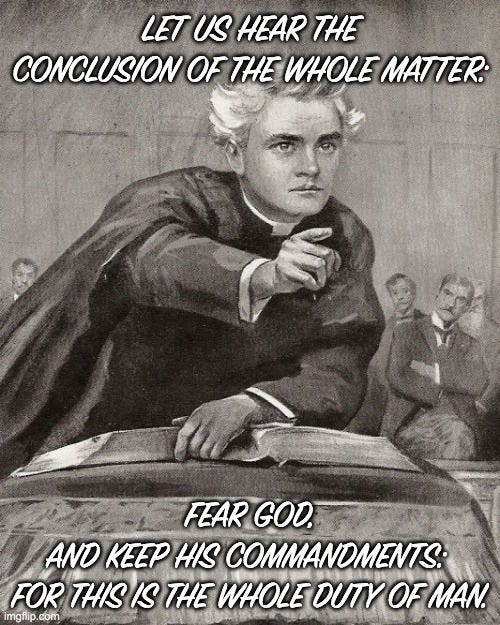
Conclusion
So, the conclusion is pretty simple: You cannot make a case for monks from Scripture. You couldn’t even when the world was relatively sane on sex and marriage, but you definitely can’t now.
Because not only are monks not what the Scriptures teach, but what the Scriptures do teach stands in such stark opposition. Even if you could find a small carve out for monasticism, it would be massively overshadowed by the Biblical values of marriage, sex, children, and raising a Godly family. Like the kid on my yard, we really shouldn’t be looking at anything else. We should be bending every effort to arrive at young, fruitful, Godly marriages. Mowing the lawn… not so much.
Links
Assigned at Birth

All cultures have their insanities. But few can have been more assigned than the modern phrase ‘Sex Assigned at Birth’.

The Significance of Vows

How often do you take a vow? If you are a regular American, I’m going to go out on a limb and say, not often. You might agree to help your friend move on Friday, but I doubt that you would go to the trouble of making a vow about it. Probably for most of us, our vows are limited to jury service and the like. Oh, and marriage.

Audience and Command

What should be our relationship with God’s commands? Can we safely leave them to a group of educated professionals? Or do we need to see them as binding each of us, every day?
Incogito has said that the vows are: poverty, celibacy, and obedience. All three are problematic, but the ‘celibacy’ one is that I am addressing here. It is a vow which says you will never marry.