

There are several ways to interpret a verse or passage. One them might be called ‘main point’ interpretation. I call it ‘handwaving’. Another might be to ignore it entirely. But what I believe in is going word by word, phrase by phrase, and seeing what the actual linguistics of the passage implies.
The method of interpretation is particularly important when addressing a passage that is controversial. Or, where one way of interpretation might be controversial.
Defrauding Monks
The overall question that we are addressing is whether monasticism is biblical. The discussion touched on various passages and various words. The passage in question that motivated this post is First Corinthians, verse five:
I Corinthians 7:5
Defraud ye not one the other,
except it be with consent for a time, that
ye may give yourselves to fasting and
prayer; and
come together again,
that Satan tempt you not for your incontinency.
Here is what it looks like in some other translations:
1Co 7:5 (Litv) Do not deprive one another, unless by agreement for a time, that you may be free for fasting and prayer. And come together again on the same place, that Satan may not tempt you through your incontinence.
1Co 7:5 (Louis Segond) Ne vous privez point l’un de l’autre, si ce n’est d’un commun accord pour un temps, afin de vaquer à la prière; puis retournez ensemble, de peur que Satan ne vous tente par votre incontinence.
1Co 7:5 (BBE) So don’t refuse sex to each other, unless you agree not to have sex for a little while, in order to spend time in prayer. Then Satan won’t be able to tempt you because of your lack of self-control.
1Co 7:5 (ASV) Defraud ye not one the other, except it be by consent for a season, that ye may give yourselves unto prayer, and may be together again, that Satan tempt you not because of your incontinency.
Defraud
Now the first thing to notice in the passage is the word ‘defraud’. We can see that the KJV and ASV use a different word than the others. They use the word ‘defraud’, which is not just a factual statement about the act, but a legal or moral implication. Other translations use lesser words usch as ‘withold’ or ‘deprive’ (privez in French).
The language that the BBE uses is contradictory to the rest of the text. Or, if you prefer, meaningless. Translated into longer language it reads, “Don’t tell your wife you won’t make love to her when she asks unless she doesn’t ask.” Say, what? If the term is ‘refuse’, then that implies that the person has asked. You don’t ‘refuse’ to give someone something that the other person doesn’t want or hasn’t asked for.1
The other words used (withhold, deprive), especially in the modern context, might have that same flavor. To the extent they do they fail the same test.
The only way that the passage can make sense is if the sexual relationship is an obligation, not a request. If the passage is speaking to the couple as a whole, not to the individuals. If it is saying, “Have sex. The only excuse for not having sex is if you agree not to for a time of prayer and fasting, and if you come back back together again before you get tempted.”
If sex is something God doesn’t require except when the other person asks for it, then the entire passage is moot. A couple who agrees together can skip sex whenever they want… why is Paul busy putting limits on it?2
With Consent
Now the phrase ‘with consent’ or ‘with agreement’ raises its own problems.
The first problem is that some people translate this as:
Always have sex
Unless you agree together not to
One reason for which might be prayer and fasting
And after your time of agreement make sure you have sex again.
The problem with that translation is not only that it violates the idea of ‘defrauding’, but also that the linguistics of the passage do not allow it. None of the translations above are in a form that, if we were to make the subject about anything but sex and throw in modern views about sex, that translation would make sense. I look forward to someone, in the comments, attempting to fill that English sentence in such a way.3
The second problem is that much more… psychological. What does ‘consent’ mean? Let me give a few examples:
The husband comes home and says that he has agreed with the pastor that he has agreed that they will have a one week sexual fast in order to pray and fast for [fill in the need here. Feel free to be as serious as you need.]4
Now, for this example we have a contradiction in Biblical principles. The husband is the head of his home, and the husband is required to keep his vow to the Lord. (Let’s throw that in there.) But… Paul here has specifically ruled that out. Paul has literally said that in the area of a sexual fast the husband is not the head of his house, and that the husband does not have the power to make such a vow. Paul has literally said ‘with consent’.
But what of the obedient wife? Surely she will ‘consent’ to obey her husband in this area? Do you see what that does to the idea of mutual consent? There would be no difference, for the obedient wife, between ‘if the husband decides’ and ‘by mutual consent’.
Now let’s turn to the wife. She is feeling uncomfortable with some aspects of life, and so says to her husband “[insert verbiage here]5… and so lets do a sexual fast for a week to pray and fast about that.”
Now, she has not attempted to command, and she has not made a vow… but we still may have a ‘consent’ problem. I will leave each couple to judge on their own, but if the husband says, “Ok, honey,” has he really consented? Or has he been guilted into it? Will he feel like a [insert negative word here] if he says no?
And in the modern context the husband is supposed to just lovingly go along with the wife wishes to abstain! So, again, the passage might as well read ‘If the wife decides’.
In other words I believe that the couple is required her to make sure that consent is really consent. Otherwise the passage should not read ‘ by mutual consent’ but ‘if either one decides’. The obedient wife, the loving husband, would both be bound if the other decides.
And! Can the consent be withdrawn? Does the word ‘consent’ means ‘consent’ and does it mean ‘consented’. If the husband consents to a three day fast, is he then bound for the three days regardless?
For a Time
Now we come to ‘for a time’. Or, as the BBE would have it ‘for a little while’.6 The first thing to notice is that this is attached to the idea of ‘except’. Or, in longer form, “Do not defraud except… for a time.” In other words it is not saying ‘feel free to defraud for as long as you feel like it’. The defrauding must be ‘for a time’.
Let us deal with a fatous objection. It is a common usage in English for someone to say something like, “The purchase of rice for the American holiday’s is only a fraction of the size of the purchase of potatoes.” And then some bright boy comes along and points out that 1/1 is a fraction. Or even 99/100. Indeed, 1500/100 is a fraction! Showing that he doesn’t understand idiomatic English.
It is possible to approach ‘it is a time’ in the same way. To point out that while an hour is ‘a time’, so is a day, a week, a year, and a century. But that approach clearly ignores the context of the command. The ‘for a time’ has both a reason and a context. The reason is ‘that Satan tempt you not’ and the context is the command to a continual sexual relationship that is marriage. This break from the sexual relationship is a ‘defrauding’. ‘For a time’ needs to be read in that light.
That Satan Tempt you Not for your Incontinency
I Corinthians 7:5f
that Satan tempt you not for your incontinency.
God provides us the sexual relationship in marriage for several reasons. Given that any definition of defrauding must deal with all of those reasons. Sex is given for pleasure, for bonding, for the production of children… it is defrauding if we abstain from sex even if one of those reasons isn’t present. Say the woman is already pregnant, and thus the production of (more) children isn’t possible. Abstaining from sex is still defrauding because you are withholding the pleasure and bonding aspects. If sex isn’t a pleasure you would still be skipping on the bonding and child production aspects.
And one of these reasons is… sexual temptation. It seems like some people have invented a Bible verse:
I Hesitations 5:6
Thou shalt avoid sexual temptation by taking long cold showers, reading a lot of Scripture (avoiding The Song), and being really active with your prayer life. An accountability group and phone blocker are also helpful.
But that is not what Scripture says. In a passage that seems offensive to pretty much everyone, Scripture says:
Proverbs 5:18-20
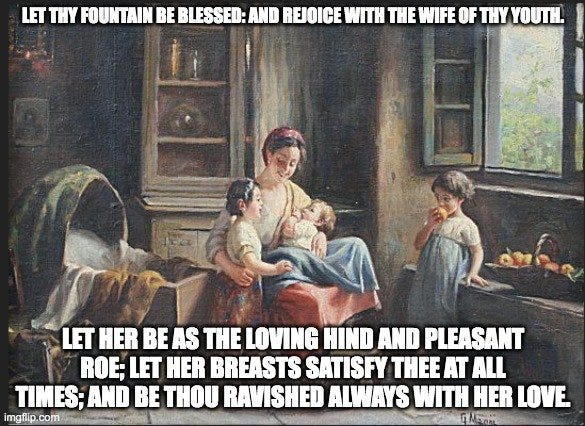
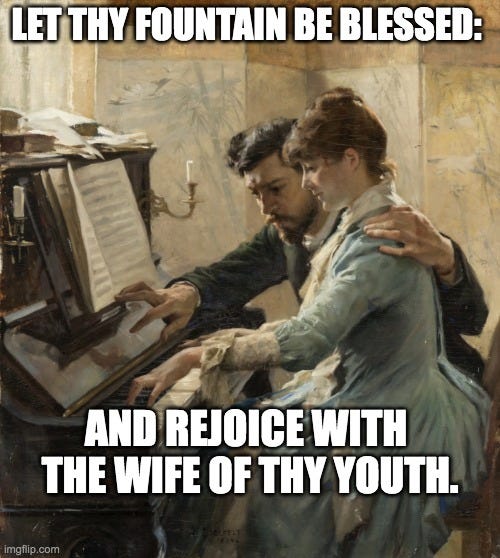
Let thy fountain be blessed: and
rejoice with the wife of thy youth.
Let her be as the loving hind and
pleasant roe;
let her breasts satisfy thee at all times; and
be thou ravished always with her love. And
why wilt thou, my son, be
ravished with a strange woman, and
embrace the bosom of a stranger?
Scripture lists one of the advantages of sex in marriage as… avoiding sexual temptation. Not cold showers, not Bible study, not accountability groups or phone blockers… letting your wife’s breasts satisfy thee at all times.7 I Corinthians Seven says the same thing… that even a special time of defrauding for prayer and fasting must only last for a time… that Satan tempt you not.
Looking at the Other words
Let’s take a look at a couple of the other words and see how they fare. We’ll start with the word ‘withhold’. Now, the idea of ‘not withholding’ fits perfectly into the previous passage. As a conclusion to those it would work wonderfully. The argument would go like this:
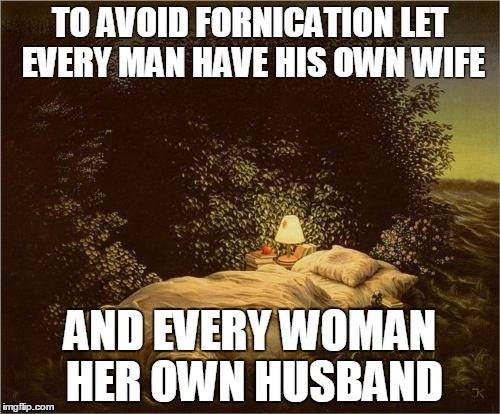
Because of fornication let every man have his own wife, and every woman her own husband.
In marriage your body belongs to you, you owe it to your spouse whenever they want to be intimate with you.
So don’t withhold sex from your spouse.
That works perfectly! It even fits into the idea of ‘mutual consent’ that some want to put into this passage. But… it doesn’t fit the rest of the passage.
Not that it is false, but the rest of the passage takes the idea further. It takes the passage beyond the mere ‘give what is asked for’, and puts the entire thing into a general command… to the couple. If the passage ended with ‘Do not defraud’, then you would have the idea of ‘have sex whenever either one of you wants’. An obligation to sex on each individual. But, ironicaly, as soon as the words ‘with mutual consent’ come in, that idea falls apart.
Which is ironic, since it seems to confirm the idea. Mutual consent seems to be exactly what is being taught, no? But even ignoring the rest of the verse, it still doesn’t work. It is still contradictory: Have sex whenever either of you want it, except when neither of you want it. What is the word ‘except’ doing there? If it read, “Have sex whenever either of you want it, the only time you shouldn’t be having sex is when neither of you want it,” make sense, if it is a bit wordy. But what price ‘except’?
The word ‘except’ (and the rest of the passage) indicate that that what is being brought up is an exception to a general rule. When it is then followed by further limitations on the exception, and then a reason for the overall command… it has to be seen not as a continuation of the previous passage, but by an augmentation. Sex in marriage is meant to be continuous, not merely something that happens when they feel like it. Indeed, when you don’t feel like it may be the most important time to have sex.
Conclusion
Scripture makes it clear that sex in marriage is supposed to be continuous… that we are to be all day, every day, engaging in foreplay. That our desire should be for our wife, and her desire for us.
And this passage makes it clear that abstaining from sex is defrauding. Even when we agree, for a time of prayer and fasting, and come together again afterwards… it is still defrauding. It is allowed, but it still falls under that term.
Still more the continual sexual denial that is modern marriage, still more the blasphemous pattern of ‘Natural Family Planning’. And even more, so much more, the blasphemous vow of non-marriage that is monasticism.
The Conversation so far
This post is part of a conversation with Incognito:
Here’s how the discussion has gone so far:
wrote a note on Substack claiming that monks were incredibly Biblical… and I disagreed. And so we agreed to do a letter exchange.
I wrote a post (I wrote it after his first post) dealing with definitions, the obvious first step in any debate.
He wrote a post claiming that celibacy and monasticism are Biblical
I wrote a post speaking about what is eternal, and what is ephemeral, in I Corinthians 7. Or, more specifically, what what local to them, and what is general to all Christians.
He wrote a post speaking about ‘eunuchs for the kingdom’.
I wrote a post about the nature of the gift that Paul speaks about I Corinthians Seven.
I wrote a post listing the examples of Godly men in Scripture who took vows of celibacy (just kidding), married, had kids, etc.
I wrote a post listing the Biblical Commands to marriage, sex, and children.
I wrote a post about calling the Fire Department: I.e., how marriage is commanded in the light of the burning of sexual temptation.
I wrote a post about how it is God, not man, who defines the terms of marriage.
We also have had various discussions in comment threads.
Thank you for reading Von’s Substack. I would love it if you commented! I love hearing from readers, especially critical comments. I would love to start more letter exchanges, so if there’s a subject you’re interested in, get writing and tag me!
Being ‘restacked’ and mentioned in ‘notes’ is very important for lesser-known stacks so… feel free! I’m semi-retired and write as a ministry (and for fun) so you don’t need to feel guilty you aren’t paying for anything, but if you enjoy my writing (even if you dramatically disagree with it), then restack, please! Or mention me in one of your own posts.
If I don’t write you back it is almost certain that I didn’t see it, so please feel free to comment and link to your post. Or if you just think I would be interested in your post!
If you get lost, check out my ‘Table of Contents’ which I try to keep up to date.
Thanks again, God Bless, Soli Deo gloria,
Von
The exception to this would be the one I speak of in defrauding… namely that if it is God you are refusing. If God says ‘have sex’ and you ‘refuse’, that would make sense. But the use of the preposition ‘to’ makes that problematic.
There might be some naive persons who think that this would even get them past ‘lest Satan tempt’ qualification as well. As if to say, “No one is ever tempted when they aren’t even asking their wife for sex.”. This person is fatally naive. It is actually a pretty common phenomenon to not ask your wife for sex when you are struggling with porn, having an affair, etc.
IOW filling in these blanks, “Do not do X, except with condition Y, for the purpose of A and B, and then stop doing X.”, and have the ‘for the purpose’ part be one of a list of possible purposes.
I am not being sarcastic here. I do not wish to trivialize the possiblities. I am encouraging my reader to fill this in with an incredibly serious prayer need… maybe a baby dying in the hospital.
Again, I am not being sarcastic, I am encouraging the reader to fill in this blank with their best argument. Even with that argument…
Which I believe is a correct interpretation but not translation.
This is not to say that lots of other things mightn’t be good, helpful, and even Biblical in their own way. But God specifically lists one specific remedy for sexual temptation for the married man: have sex with your wife. And for the unmarried man? Get married.