

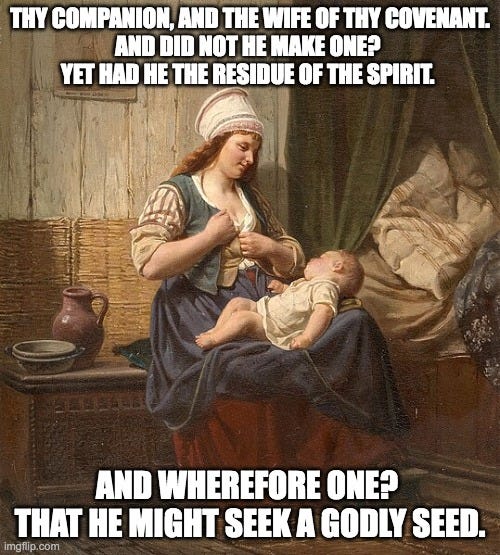
“To many God gives children in place of temporal good. To many others he gives houses, lands, and thousands of gold and silver, and with them the womb that beareth not; and these are their inheritance. The poor man has from God a number of children, without lands or money; these are his inheritance; and God shows himself their father, feeding and supporting them by a chain of miraculous providences. Where is the poor man who would give up his six children with the prospect of having more, for the thousands or millions of him who is the centre of his own existance, and has neither root nor branches but his forlorn, solitary self upon the face of the earth? Let the fruitful family, however poor, lay this to heart: ‘Children are an heritage of the Lord: and the fruit of the womb is his reward.’ And he who gave them will feed them; for it is a fact, and the maxim formed on it has never failed, ‘Whenever God sends mouths, he sends meat.’ ‘Murmur not,’ said an Arab to his friend, ‘because thy family is large; know that it is for their sakes that God feeds thee.’”
Adam Clarke, quoted in Spurgeon’s Treasury of David 1760-1832
Adam Clarke
Commentary on Psalm 128
Psalms 128:3
Thy wife shall be as a fruitful vine - Thy children, in every corner and apartment of thy house, shall be the evidences of the fruitfulness of thy wife, as bunches of grapes on every bough of the vine are the proofs of its being in a healthy thriving state. Being about the house sides, or apartments, is spoken of the wife, not the vine; being around the table is spoken of the children, not of the olive-plants. It does not appear that there were any vines planted against the walls of the houses in Jerusalem, nor any olive-trees in pots or tubs in the inside of their houses; as may be found in different parts of Europe.
Psalms 127:5
Happy is the man that hath his quiver full of them - This is generally supposed to mean his house full of children, as his quiver if full of arrows; but I submit whether it be not more congenial to the metaphors in the text to consider it as applying to the wife: “Happy is the man who has a breeding or fruitful wife;” this is the gravida sagittis pharetra “the quiver pregnant with arrows.” But it may be thought the metaphor is not natural. I think otherwise: and I know it to be in the Jewish style, and the style of the times of the captivity, when this Psalm was written, and we find the pudendum muliebre, or human matrix, thus denominated, Ecclus. 26:12: Κατεναντι παντος πασσαλου καθησεται, και εναντι βελους ανοιξει φαρετραν. The reader may consult the place in the Apocrypha, where he will find the verse well enough translated.
Thank you for reading Von’s Substack. I would love it if you commented! I love hearing from readers, especially critical comments. I would love to start more letter exchanges, so if there’s a subject you’re interested in, get writing and tag me!
Being ‘restacked’ and mentioned in ‘notes’ is very important for lesser-known stacks so… feel free! I’m semi-retired and write as a ministry (and for fun) so you don’t need to feel guilty you aren’t paying for anything, but if you enjoy my writing (even if you dramatically disagree with it), then restack, please! Or mention me in one of your own posts.
If I don’t write you back it is almost certain that I didn’t see it, so please feel free to comment and link to your post. Or if you just think I would be interested in your post!
If you get lost, check out my ‘Table of Contents’ which I try to keep up to date.
Thanks again, God Bless, Soli Deo gloria,
Von