

Judges 11:37-40
And she said unto her father, Let this thing be done for me: let me alone two months, that I may go up and down upon the mountains, and
bewail my virginity,
I and my fellows.
And he said, Go. And he sent her away for two months: and she went with her companions, and
bewailed her virginity upon the mountains.
And it came to pass at the end of two months, that she returned unto her father, who did with her according to his vow which he had vowed: and
she knew no man.
And it was a custom in Israel,
That the daughters of Israel went yearly to lament the daughter of Jephthah the Gileadite four days in a year.
Some things are designed to be temporary. When we look at the human body, we will notice that the developing fetus, the developing baby in the womb, has certain anatomical features that are literally designed to go away at birth. These features of their anatomy support them in the womb but would be very detrimental once they are out of it. I’m not gonna go into great detail, but you can look it up. 1
And then there are many other issues of anatomy and indeed of human social behaviour that are designed to be temporary. And so, for example, babies are designed to drink milk from their mothers. Indeed, at the very beginning, the milk that they drink is different than the milk they will drink later. But for most of us, if we see a 20-year-old boy drinking milk from his mother, we would be rather clear that that was not part of the design.
I wish to put forward the thesis that virginity is one of those things that are designed by God to be temporary. Indeed, I will argue that for anyone who is not now a virgin, there was a time when they were. God has designed human development such that anatomy, physiology, psychology, and sociology are all literally designed for virginity to be temporary.
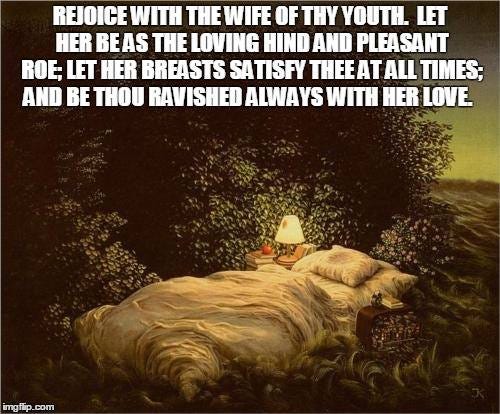
Just born
Now, there are certain perverse psychologists who make a big fuss about the sexuality of newborns. I suppose they might even expand their bizarre theories to inside the womb. However, for most of us, we understand that human babies do not engage in sexual behaviour. We recognise that they are not even capable of beginning to think about understanding sexual behaviour.
I’m growing up
And then we all recognised that there comes a time, indeed a series of times in the child’s life, where this begins to change. The famous song I Saw Mommy Kissing Santa Claus is a recognition of the fact that children begin to distinguish between the ways they understand different adults’ different behaviour. That even before they are told all about the birds and the bees, they understand that there are different manners of physical and social attraction, one of which happens between men and women. Mommy and Daddy.
The birds and the bees
Song 8:8-9
We have a little sister, and she hath no breasts: what shall we do for our sister in the day when she shall be spoken for?
If she be a wall, we will build upon her a palace of silver: and if she be a door, we will inclose her with boards of cedar.
And then there comes a time, typically a very awkward time, when the child’s body and mind begin to understand in both an intellectual and a psychological way that they themselves are caught up in this great dance. They begin to be very curious about the body of the opposite sex, and they begin to have thoughts about doing various things that, in an adult, we would classify as sexual. And yet they’re in a stage where those things are still, shall we say, a bit behind a pay wall.

All grown up
And then there comes a time when the child is no longer a child. When it comes to their anatomy, physiology, and psychology, they are all grown up. The social group they are part of may still have huge restrictions placed on them, but no one denies that all parts are present and accounted for. And yet in almost no society on earth is this child already in a sexual relationship, let alone what might be considered a legitimate sexual relationship. The kind that we tend to call married.
God’s design
Now, for the vast majority of people over the vast majority of history, the next step is that the child actually enters into a sexual relationship. They get, to coin a phrase, ‘married’.
And now let’s bring God back into this discussion. To what extent would anyone be willing to say that there is something about the timeline that I have outlined that is against God’s design? Does anyone claim that God wishes for newborns to be married? For eight-year-olds to be going on a honeymoon? To the best of my knowledge, no one who actually believes in God and his creation has ever made any such claim.
So, in other words, everyone agrees that God has designed virginity to be temporary. God has designed it so that in every man’s life there is a time before he is married… and a time after. And no one denies that the time of virginity is a good thing. No one ever says, “Boy, I wish that this two-year-old was able to get married. It’s a shame that his body isn’t ready.” And so here is the conclusion that I am drawing: virginity is a good thing, and it is designed to be temporary. The point of virginity is that it is a preparation for marriage.
Back to Monks
And now we come to how this impacts our discussion about monks. My opponent in that discussion has made the incredibly interesting logical leap that if something is good at one point, it must be good at all other points.
What he actually said was:
Von might insist that this still is not a vow. But that misses the point. Is perpetual virginity something God rewards? All the passages above seem to say so. If that is the case, vowing to do perpetually do something God approves of our perpetually doing cannot be intrinsically against God’s plan.
And that seems to be the logical conclusion. Here we have this thing he calls ‘celibacy’, and I call ‘being unmarried’, and he sees it as a good thing. But then he reasons that because it is a good thing, it must therefore always be a good thing. That because being unmarried is a good thing for part of life that means it must be a good thing for all of life!
(Reading only this quote might make it seem as if the case he made was that ‘perpetual’ unmarriedness was something Scripture teaches. However, that is a bit of sleight of hand. The passages he points to make the claim, at best, that being unmarried is good for someone at some point in their life. Neither the word ‘perpetual’ nor the concept occurs in any of the passages he quotes.)
I will make an analogy that I mentioned before. I believe that breastfeeding is a good thing. I believe that it is a very good thing for an infant to drink milk directly from their mother’s breast. However, I think this is a temporary good thing. Having lived in Africa, I would be very open to seeing it being done longer than it typically is here in the United States, but even amongst primitive people, 20-year-old boys are still not nursing from their mothers. Breastfeeding is a very good thing, but it is a temporary good thing. It is a very good thing that God has designed to be temporary.
Many of us have learned a language as adults. And all of us have learned a language when we were very young. (If you haven’t learned a language, then you’re not reading this or listening to it.) But those of us who have studied the physiology and psychology of language learning all understand that the attributes of a human being that make it so easy for the baby to learn the language are attributes that go away as the child gets older. This is not to say that it’s impossible for a 20-year-old or even a 60-year-old to learn a new language, but their brains are not adapted to it in the same way that a baby’s is.
So let me repeat my formula: Virginity is a good thing that God has designed as a temporary good thing.
What If?
There are good things which are good things, even though they are designed to be temporary. There are things that are good for a while. Things we grow out of.
So here are my questions for the pro-monk side of the argument. Some of them, anyway:
Is the young man who takes a vow of unmarriage stating that he knows that, for the rest of his life, God will never call him to be married?
Is the young man who takes a vow of unmarriage stating that he knows that he has, and God will always give him, the gift of remaining sexually continent? That he will never burn with lust?
Is the young man… saying that he knows God will not call, will never call him, him, to have children and raise a Godly family?
Now, all of these questions, which are but a part of the questions I could ask, apply equally to all the other parts of being a monk: the contemplative life, the vow of poverty, the vow of obedience. But here’s another question, that fits all of the vows:
Who is your Biblical hero? Have you examined your vows in light of that hero? Cause I can guarantee that they don’t fit.
I mean, consider the list. Daniel, Paul, and Christ may have fit into the ‘celibacy’ aspect (I’m assuming Daniel had been castrated, and ignoring the probability that Paul had been married), but not the vow part, and certainly not the ‘contemplative life’ part! I suppose the beggar at the door of the rich man had some time for contemplation and was certainly poor (although, again, there was no vow involved), but where was the rule of obedience?
No, what is certain for anyone who knows their Scripture is that there are no Biblical heroes who can serve as examples for the young monk. The overwhelming majority of Godly figures were married, and God spoke of blessing them with children. Most OT Biblical heroes were rich. All of them were out there, engaged with the world, business, neighbours, even wars.
And all of them, at one point in their life, were virgins, penniless, and under a rule of obedience (typically called ‘a mother’). But for most of them, all of those good things were… temporary. And none of them were locked down with a vow.2
Thank you for reading Von’s Substack. I would love it if you commented! I love hearing from readers, especially critical comments. I would love to start more letter exchanges, so if there’s a subject you’re interested in, get writing and tag me!
Being ‘restacked’ and mentioned in ‘notes’ is very important for lesser-known stacks so… feel free! I’m semi-retired and write as a ministry (and for fun) so you don’t need to feel guilty you aren’t paying for anything, but if you enjoy my writing (even if you dramatically disagree with it), then restack, please! Or mention me in one of your own posts.
If I don’t write you back it is almost certain that I didn’t see it, so please feel free to comment and link to your post. Or if you just think I would be interested in your post!
If you get lost, check out my ‘Table of Contents’ which I try to keep up to date.
Thanks again, God Bless, Soli Deo gloria,
Von
https://www.cincinnatichildrens.org/health/f/fetal-circulation
We do read of other vows, such as the Nazarite vow. I am a bit surprised that they haven’t been brought into the conversation.