
Carnal Delights
... and Nebucadnezzer's statue

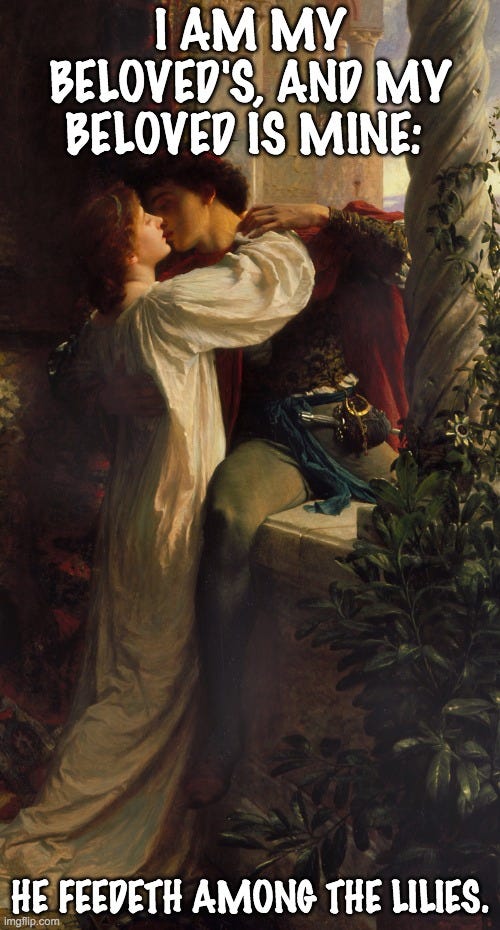
Let’s face it, the Song of Solomon is not the easiest book to interpret. Read one way its erotic literature, read another way it expresses the eternal spiritual union between Christ and the church. Read another way… well, that is the question. What other ways can one read it?
The Head of the Problem
Let’s change subjects for a few minutes and talk about a certain statue:
Daniel 2:31-36
Thou, O king, sawest, and behold a great image. This great image, whose brightness was excellent, stood before thee; and the form thereof was terrible.
This image’s head was of fine gold,
his breast and his arms of silver,
his belly and his thighs of brass,
His legs of iron,
his feet part of iron and part of clay.
Thou sawest till that a stone was cut out without hands, which smote the image upon his feet that were of iron and clay, and brake them to pieces.
Then was the iron, the clay, the brass, the silver, and the gold, broken to pieces together, and became like the chaff of the summer threshingfloors; and the wind carried them away, that no place was found for them: and the stone that smote the image became a great mountain, and filled the whole earth.
This is the dream; and we will tell the interpretation thereof before the king.
Let me ask you a weird question… did this statue have a head? You stare at me in confusion, so let me try again: did this statue have a head? Or does the word head here mean something else?
Let’s walk through the issue:
This was a dream, so there was not actually a statue. In that sense, then, it didn’t have a head.
But in the dream, our boy Neb saw something… what did he see? Was it, as the Sunday School colouring books suggest… a statue? A statue with feet, legs, torso, arms… and a head? Or was it, perhaps, some vague shape and ‘head’ is put for the top, and ‘toes’ for the bottom?
If the statue, in the dream, had a head, did the head stand for a head… or was it a metaphor for something else?
So… in the common interpretation, there was no head, because it was a dream, but in the dream there was a head, but the head did not stand for a head, but for something else (the reign of our boy Neb). Clear?
So what we have is a dream, and in that dream a body, and from that body a metaphor. It would be wrong for someone to say that Neb had seen a statue from his back window, in the real world.
But it is just as wrong, and downright weird, for someone to say that there was, even in the dream, no statue, and no head. No toes, no feet, no legs no arms… and no head. To take the story straight from dream to meaning. To merely say, “This king dreamed about the importance of his reign, and the reign of those who would follow him.” is to ignore the fact that there was a statue in his dream, and the statue had a head.
So let me be very clear about how I believe this analysis applies to the Song of Solomon. When the Song poetically describes the bodies of the two lovers, from their breasts to their voices, and frequently shows them engaged in sexual activity, from kissing to embracing and beyond… it is perfectly acceptable for the commentator to arrive at some great spiritual point. But along the way they cannot deny the statue had a head. They cannot deny that whatever spiritual point they believe is being taught in the Song of Solomon, that spiritual point was made using a metaphor of human sexual activity.
And when mentioning that, when talking about the human sexual activity in the Song of Solomon, they must rightly interpret that activity. A ‘kiss’ cannot be transformed into a mere longing for spiritual oneness. That a description of the breasts of a woman is limited to a certain relationship with that woman. When reading Biblical metaphors, we should not try to deny that snow is actually white, and sheep do go astray.
The Kisses
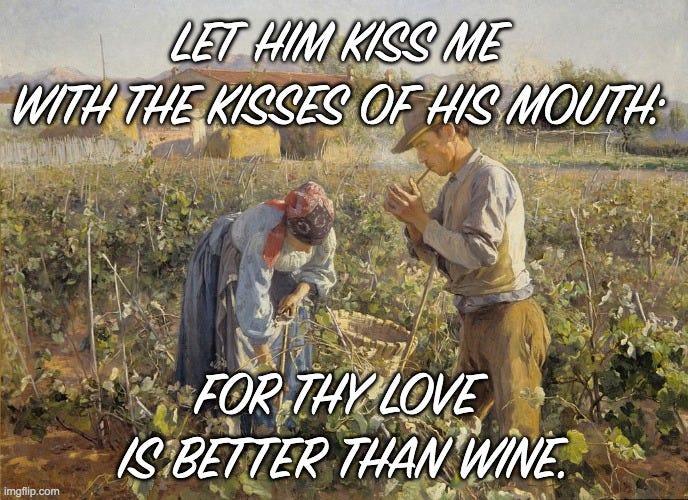
And thus we come to the Song of Solomon, and kisses and breasts and all. Because that final error is one that a lot of commentators seem to make when coming at the Song. They begin with a dream (probably a day dream), a girl laying on her bed and imagining all sorts of wonderful things… and then skip straight to the importance of the dream, the interpretation of the dream. Christ, the church, spiritual affection… and all that.
But they leave off the head. Or, in this case, the breasts. The thighs. The navels. Indeed, the girl and the guy. Indeed, they often seem to suggest that if the Song really did involve a guy and a girl, a man and his girlfriend, a husband and his wife… that the Song would then involve some sinful activity. That if Solomon had actually been describing, right there in public, his wife’s breasts and naval and she had been talking about where he put his hands when he embraced her… well… let’s skip straight to how Christ loves the church.
Modesty
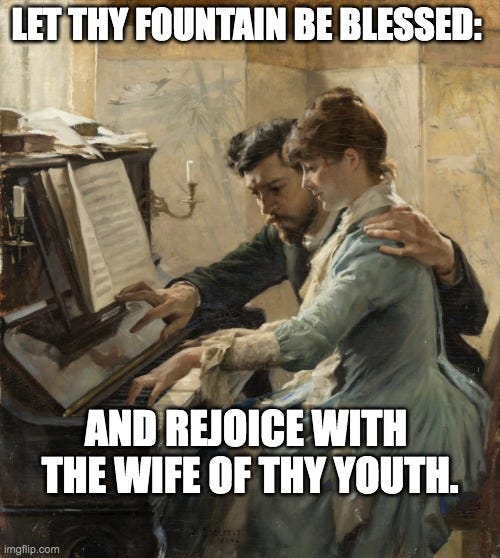
Now, I think for a lot of commentators the reason they do this is for ‘modesty’. They take for granted that the audience will have understood the physical acts described in the Song… and that what they want the preacher to focus on (after all, children are present) is the spiritual meaning that that should have in our lives.
Ok, we’ve all done that. We’ve all been preaching to a mixed audience and had to deal with ‘Thou shalt not commit adultery’. And while our explanations of ‘Thou shalt not steal’ included some fun stories of thieves breaking into houses, we were rather less specific and detailed about the whole ‘adultery’ thing. “The love of a man for his wife has a unique expression that is only appropriate in that relationship,” we might have said.
But God forbid that we leave any of our adult audience thinking that that as long as their love for their wife was ‘unique’, visiting prostitutes was fine. The underlying meaning, the physical meaning, was still true… even while we concentrated our public preaching on ‘unique relationships’ and ‘spiritual oneness’.
Carnal
But then we face another type of issue. People who would deny the validity of the metaphor. When the woman lays on her couch dreaming of his kisses, and his right hand embracing her, we hear things like this, “She is not expressing a carnal desire for sexual satisfaction.”
That’s a fun sentence, eh? Let’s play with it a bit. Is she expressing a carnal desire for spiritual satisfaction? Is she expressing a spiritual desire for sexual satisfaction? Has she had ‘the talk’ with her mother? Does she even know what sex is?
carnal(adj.)
c. 1400, “physical, human, mortal,” from Old French carnal and directly from Latin carnalis “fleshly, of the flesh,” from carnis “of the flesh,” genitive of caro “flesh, meat,” probably originally “a piece of flesh” (from PIE root *sker- (1) “to cut”).
The meaning “sensual, pertaining to the passions and appetites of the flesh” is from early 15c.; that of “worldly, sinful, not spiritual” is from mid-15c.
Carnal suggests that which belongs to the gratification of the animal nature ; it ranges from the merely unspiritual to the sensual. [Century Dictionary]
Carnal knowledge “sexual intercourse” is attested from early 15c. and was in legal use by 1680s. Medieval Latin carnalis meant “natural, of the same blood,” a sense sometimes found in Middle English carnal.
-Webster’s 1828
CARNAL, adjective
1. Pertaining to flesh; fleshly; sensual; opposed to spiritual; as carnal pleasure.
2. Being in the natural state; unregenerate.
The carnal mind is enmity against God. Romans 8:7.
3. Pertaining to the ceremonial law; as carnal ordinances. Hebrews 9:10.
4. Lecherous; lustful; libidinous; given to sensual indulgence.
CARNAL-knowledge, sexual intercourse.
-etymonline
The root meaning of the word ‘carnal’ is ‘flesh’. As in the natural world, physical reality. Not spiritual or mental, but physical. Not a difficult point in a debate, not a fantastic bit of knowledge about who God is, but a hand, a foot, a breast. Flesh. Physical.
So when the commentator says that the woman in the Song is not ‘expressing a carnal desire’, our first thought must be that she is not thinking of anything that would involve her body, or his body. That her desires are bodiless.
The second meaning of ‘carnal’ is ‘anti-spiritual’. That meaning is one of those ‘comparison’ meanings (and the reason why grandma never tells any of her grandchildren that she likes their pictures best, and hangs them all on her fridge). A ‘carnal’ pleasure is, in this meaning, a pleasure that one engages in in an illegitimate way… focusing purely on what feels good, instead of what is morally good.
This is the most dangerous of all possible interpretations. It would literally turn the Song of Solomon on its head. We are told, very clearly, in Scripture that the physical desire of a wife for her husband (and vice versa) is a good thing. A good thing to be encouraged. So unless the interpreter is saying that the wife is desiring sexual satisfaction with her husband, and that that is a good thing and not merely ‘carnal’, not merely a satisfying of the flesh outside of the God given and commanded relationship… the word ‘carnal’ is very dangerous here.
So we need to clear here: the Song clearly brings forward the sexual activity of a man and a woman as a metaphor. Or an instruction. That sexual activity is good. To read the sexual activity that the song describes as bad, evil, out of place, would be to turn the Song on its head. Any interpretation of the Song to bring forward the metaphor must include, or at the very least must not deny, the nature of the metaphor: both that it is sexual, and that it is good.
Carnal Poetry
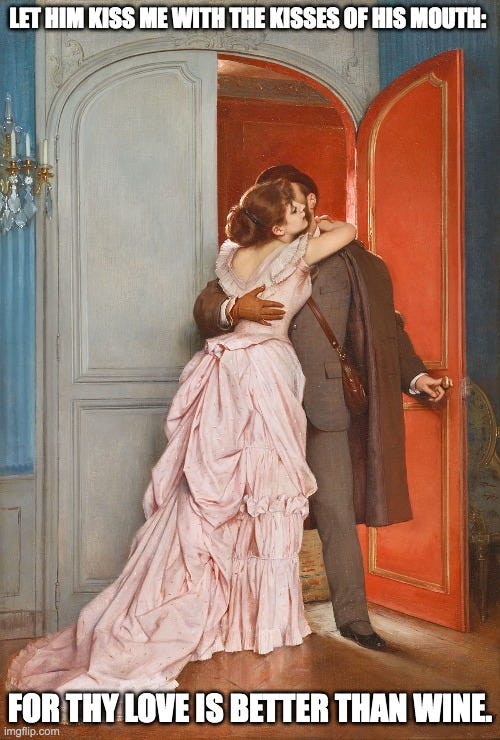
So, if there is sex in the Song, how much is there? If the Song is actually using the metaphor of sexual intimacy between a man and his wife to teach us about, well, lots of things… where is this sex? What does it look like?
Well, first of all, we need to look at the ways of talking about sex in Scripture. In prose and poetry.
Prose
Genesis 2:24
Therefore shall a man leave his father and his mother, and
shall cleave unto his wife: and
they shall be one flesh.
Genesis 4:1
And Adam knew Eve his wife; and
she conceived, and bare Cain, and said, I have gotten a man from the LORD.
Genesis 16:2
And Sarai said unto Abram, Behold now, the LORD hath restrained me from bearing: I pray thee,
go in unto my maid;
it may be that I may obtain children by her. And Abram hearkened to the voice of Sarai.
Genesis 17:16
And I will bless her, and give thee a son also of her: yea,
I will bless her,
and she shall be a mother of nations;
kings of people shall be of her.
Genesis 20:6
And God said unto him in a dream, Yea, I know that thou didst this in the integrity of thy heart; for I also withheld thee from sinning against me: therefore
suffered I thee not to touch her.
Genesis 21:1
And the LORD visited Sarah as he had said, and the LORD did unto Sarah
as he had spoken.
Genesis 21:2
For Sarah conceived, and bare Abraham a son in his old age, at the set time of which God had spoken to him.
Genesis 18:14
Is any thing too hard for the LORD? At the time appointed I will return unto thee, according to the time of life, and
Sarah shall have a son.
Genesis 39:7
And it came to pass after these things, that his master’s wife cast her eyes upon Joseph; and she said,
Lie with me.
Lev 18:6
None of you shall approach to any that is near of kin to him,
to uncover their nakedness:
I am the LORD.
Genesis 49:4
Unstable as water, thou shalt not excel; because
thou wentest up to thy father’s bed;
then defiledst thou it:
he went up to my couch.
Genesis 24:67
And Isaac brought her into his mother Sarah’s tent,
and took Rebekah, and
she became his wife; and
he loved her: and
Isaac was comforted after his mother’s death.
Hebrews 13:4
Marriage is honourable in all, and
the bed undefiled: but
whoremongers and
adulterers God will judge.
Genesis 38:16
And he turned unto her by the way, and said, Go to, I pray thee,
let me come in unto thee;
(for he knew not that she was his daughter in law.)
And she said, What wilt thou give me, that thou mayest
come in unto me?
I Samuel 2:20
And Eli blessed Elkanah and his wife, and said,
The LORD give thee seed of this woman
for the loan which is lent to the LORD.
And they went unto their own home.
I Samuel 2:21
And the LORD visited Hannah,
so that she conceived,
and bare three sons and two daughters.
And the child Samuel grew before the LORD.
I Corinthians 7:3
Let the husband render unto the wife due benevolence: and
likewise also the wife unto the husband.
I Corinthians 7:4
The wife hath not power of her own body, but the husband: and
likewise also the husband hath not power of his own body, but the wife.
I Corinthians 7:5
Defraud ye not one the other, except it be with consent for a time, that ye may give yourselves to fasting and prayer; and
come together again,
that Satan tempt you not for your incontinency.
Poetry
Proverbs 5:15-20
Drink waters out of thine own cistern, and
running waters out of thine own well.
Let thy fountains be dispersed abroad, and
rivers of waters in the streets.
Let them be only thine own, and not strangers’ with thee.
Let thy fountain be blessed: and
rejoice with the wife of thy youth.
Let her be as the loving hind and pleasant roe;
let her breasts satisfy thee at all times; and
be thou ravished always with her love.
And why wilt thou, my son,
be ravished with a strange woman, and
embrace the bosom of a stranger?
Proverbs 7:18
Come,
let us take our fill of love until the morning:
let us solace ourselves with loves.
Proverbs 6:29
So he that goeth in to his neighbour’s wife;
whosoever toucheth her shall not be innocent.
Ecclesiastes 6:3
If a man beget an hundred children,
and live many years, so that the days of his years be many, and his soul be not filled with good, and also that he have no burial; I say, that an untimely birth is better than he.
In the Song
Now, given that list of ways of referring to sex and sexual activity in dramatic and continual euphemism, let’s look list of all potential sexual activity in the Song. For each one I encourage you to look back at the list of words above. And not only the words, but the type of words. The nature of the euphemism… ing.
In English we might say ‘the birds and the bees’, we might say ‘one enchanted evening’. We speaking of ‘making love’, ‘time together, and ‘intercourse’.1 There are lots (and lots) of ways that we refer to sexual activity, some more obvious, some less obvious. In Hebrew, including Hebrew poetry, use lots of others. The most obvious might be said to be ‘knew his wife’. The most blunt might be ‘embrace her’. I’m not sure what the least blunt might be but perhaps ‘brought her into his chambers’ or ‘took her’. And sometimes the event itself is just winked at… as in ‘give thee seed of this woman’… but we know of the activity that produces that.
Indeed the most common reference to sex in the Scripture is the word ‘begat’, the most common phrase ‘son of’. In long form, ‘begat’ is translated, ‘this is the man who had sex with the mother of this child, and that sexual activity produced this child.” Ditto translation of ‘son of’ with appropriate grammatical changes. Indeed even the word ‘seed’ reference sex, as does ‘from thy loins’… none of which I have referenced above.
So when we come to the Song, that is the range of things we should be looking for:
Song 1:2
Let him kiss me with the kisses of his mouth: for
thy love is better than wine.
Song 1:4
Draw me, we will run after thee:
the king hath brought me into his chambers:
we will be glad and rejoice in thee,
we will remember thy love more than wine: the upright love thee.
Song 1:9-10
I have compared thee, O my love, to a company of horses in Pharaoh’s chariots.
Thy cheeks are comely with rows of jewels,
thy neck with chains of gold.
Song 1:13
A bundle of myrrh is my wellbeloved unto me;
he shall lie all night betwixt my breasts.
Behold, thou art fair, my love; behold, thou art fair;
thou hast doves’ eyes.
Behold, thou art fair, my beloved, yea, pleasant:
also our bed is green.
Song 2:3
As the apple tree among the trees of the wood, so is my beloved among the sons.
I sat down under his shadow with great delight, and
his fruit was sweet to my taste.
He brought me to the banqueting house, and
his banner over me was love.
Song 2:6
His left hand is under my head, and
his right hand doth embrace me.
Song 2:16
My beloved is mine, and I am his:
he feedeth among the lilies.
Until the day break, and the shadows flee away, turn, my beloved, and
be thou like a roe or a young hart upon the mountains of Bether.
Song 3:4
It was but a little that I passed from them, but I found him whom my soul loveth:
I held him, and would not let him go, until
I had brought him into my mother’s house, and
into the chamber of her that conceived me.
Song 4:1-7
Behold, thou art fair, my love; behold, thou art fair;
thou hast doves’ eyes within thy locks:
thy hair is as a flock of goats, that appear from mount Gilead.
Thy teeth are like a flock of sheep that are even shorn, which came up from the washing; whereof every one bear twins, and none is barren among them.
Thy lips are like a thread of scarlet, and thy speech is comely: thy temples are like a piece of a pomegranate within thy locks.
Thy neck is like the tower of David builded for an armoury, whereon there hang a thousand bucklers, all shields of mighty men.
Thy two breasts are like two young roes that are twins, which feed among the lilies.
Until the day break, and the shadows flee away,
I will get me to the mountain of myrrh, and
to the hill of frankincense.
Thou art all fair, my love;
there is no spot in thee.
Song 4:9-15
Thou hast ravished my heart, my sister, my spouse;
thou hast ravished my heart with one of thine eyes,
with one chain of thy neck.
How fair is thy love, my sister, my spouse!
how much better is thy love than wine!
and the smell of thine ointments than all spices!
Thy lips, O my spouse, drop as the honeycomb:
honey and milk are under thy tongue;
and the smell of thy garments is like the smell of Lebanon.
A garden inclosed is my sister, my spouse; a spring shut up, a fountain sealed.
Thy plants are an orchard of pomegranates, with pleasant fruits; camphire, with spikenard,
Spikenard and saffron; calamus and cinnamon, with all trees of frankincense; myrrh and aloes, with all the chief spices:
A fountain of gardens, a well of living waters, and streams from Lebanon.
Song 4:16
Awake, O north wind; and
come, thou south; blow upon my garden, that the spices thereof may flow out.
Let my beloved come into his garden,
and eat his pleasant fruits.
Song 5:1
I am come into my garden, my sister, my spouse:
I have gathered my myrrh with my spice;
I have eaten my honeycomb with my honey;
I have drunk my wine with my milk:
eat, O friends;
drink, yea,
drink abundantly, O beloved.
Song 5:10
My beloved is white and ruddy, the chiefest among ten thousand.
His head is as the most fine gold,
his locks are bushy, and black as a raven.
His eyes are as the eyes of doves by the rivers of waters, washed with milk, and fitly set.
His cheeks are as a bed of spices, as sweet flowers:
his lips like lilies, dropping sweet smelling myrrh.
His hands are as gold rings set with the beryl:
his belly is as bright ivory overlaid with sapphires.
His legs are as pillars of marble, set upon sockets of fine gold:
his countenance is as Lebanon, excellent as the cedars.
His mouth is most sweet: yea, he is altogether lovely.
This is my beloved, and this is my friend, O daughters of Jerusalem.
Song 6:2
My beloved is gone down into his garden,
to the beds of spices,
to feed in the gardens, and
to gather lilies.
Song 6:4-9
Thou art beautiful, O my love, as Tirzah,
comely as Jerusalem, terrible as an army with banners.
Turn away thine eyes from me, for they have overcome me:
thy hair is as a flock of goats that appear from Gilead.
Thy teeth are as a flock of sheep which go up from the washing, whereof every one beareth twins, and there is not one barren among them.
As a piece of a pomegranate are thy temples within thy locks.
There are threescore queens, and fourscore concubines, and virgins without number.
My dove, my undefiled is but one; she is the only one of her mother, she is the choice one of her that bare her. The daughters saw her, and blessed her; yea, the queens and the concubines, and they praised her.
Song 7:1-10
How beautiful are thy feet with shoes, O prince’s daughter!
the joints of thy thighs are like jewels, the work of the hands of a cunning workman.
Thy navel is like a round goblet, which wanteth not liquor:
thy belly is like an heap of wheat set about with lilies.
Thy two breasts are like two young roes that are twins.
Thy neck is as a tower of ivory;
thine eyes like the fishpools in Heshbon, by the gate of Bathrabbim:
thy nose is as the tower of Lebanon which looketh toward Damascus.
Thine head upon thee is like Carmel, and
the hair of thine head like purple;
the king is held in the galleries.
How fair and how pleasant art thou, O love, for delights!
This thy stature is like to a palm tree,
and thy breasts to clusters of grapes.
I said, I will go up to the palm tree,
I will take hold of the boughs thereof:
now also thy breasts shall be as clusters of the vine, and
the smell of thy nose like apples;
And the roof of thy mouth like the best wine for my beloved, that goeth down sweetly, causing the lips of those that are asleep to speak.
I am my beloved’s, and
his desire is toward me.
Song 7:12
Let us get up early to the vineyards; let us see if the vine flourish, whether the tender grape appear, and the pomegranates bud forth:
there will I give thee my loves.
Song 8:1-4
O that thou wert as my brother, that sucked the breasts of my mother! when I should find thee without,
I would kiss thee; yea, I should not be despised.
I would lead thee, and bring thee into my mother’s house, who would instruct me:
I would cause thee to drink of spiced wine of the juice of my pomegranate.
His left hand should be under my head, and
his right hand should embrace me.
Song 8:14
Make haste, my beloved, and
be thou like to a roe or to a young hart upon the mountains of spices.
The Wolf Whistle
Genesis 24:16
And the damsel was
very fair to look upon,
a virgin, neither had any man known her:
and she went down to the well,
and filled her pitcher,
and came up.
Now, one might have seen that I bolded a lot of words that were, basically, a verbal wolf whistle. Words where a man, or woman, is looking at the body of a person of the opposite sex, and expressing admiration. And not even general, vague, admiration… as we read about Rebecca and various others. But going through the person’s body, area by area, describing them in detail… the eyes, the voice, the neck, the breasts, the navel, the joints of the thighs… and the taste of the roof of their mouth.
Conclusion
Job 31:1
I made a covenant with mine eyes;
why then should I think upon a maid?
Can one have sex that is not carnal sex? Can one look forward to sexual activity in a non-carnal fashion.
Can a man who is not married (consummated or betrothed) to a woman legitimately think about having sex with a woman? Can he legitimately and morally speak, and one assumes think, about much he likes her breasts or her navel? Can she admire the joints of his thighs?
Are either of those consistent with Biblical, Godly thinking and action?
And when we think of this passage as, instead, a description of married love then, even if we are eager to move to the metaphor or Christ and the church… we should probably pause a second and remark on the fact that if God (via Solomon) chose to use this particular poem describing the love between a man and his wife as his example to teach us about the relationship between Christ and the church (and I’m a little confused why Solomon would be writing a description of the love between Christ and the church without a couple of footnotes)… then perhaps even men and wives should be paying attention to the metaphor? That perhaps, as Paul did in Ephesians 5, we should be taking the relationship of the Christ and the church as a guide for how we should be managing our own sex life?
For the Future
Why is this important? Well, one trivial reason is that some people might see the Song as teaching us ‘how to handle our courtship’, which is pretty clearly erroneous.
But the more important reason is that very few married Christians seem to either practice or teach the Song as being a ‘how to handle your marriage’ book. Indeed, I’m afraid that if you were to divorce the Song from the Bible… somehow wrap it in brown paper so it was anonymous… many modern Christians, of all stripes, would actually denounce the principles found in it.
I mean, just imagine that some modern Christian man were, in public, to talk about how much he liked his wife’s breasts… let alone publish his description in poetry! Some newly married wife sitting around in a woman’s Bible study talking about how much she liked her husband’s thighs!
No, I’m afraid that for many couples the Song is offlimits. In public and in private. Rejoicing continually has been relegated to alternate Thursdays.
I believe the Song has a lot to tell us. Indeed, a lot to condemn us for.
Links
Is God a Metaphor

“Logic!" said the Professor half to himself. "Why don't they teach logic at these schools? There are only three possibilities. Either your sister is telling lies, or she is mad, or she is telling the truth. You know she doesn't tell lies and it is obvious that she is not mad. For the moment then and unless any further evidence turns up, we must assume t…
Biblical Sex

Why on Earth should we have sex? No, literally. Why, here on Earth, in our current sinful condition, do we have sexual intercourse. Kissing and… ummm… everything? Does it have a point? Does it have several?? Does God say???
Biblical Sex: Fiction

Behold, thou art fair, my love; behold, thou art fair; thou hast doves' eyes within thy locks: thy hair is as a flock of goats, that appear from mount Gilead.


A modern reader might be a bit confused by the word ‘intercourse’. Most modern Americans would see that word as merely meaning sexual activity. They might be a bit confused by why someone would say ‘sexual intercourse’. But the word ‘intercourse’ did not at all mean sex when it was first invented: intercourse(n.)
mid-15c., entercours, “communication to and fro,” originally in English with reference to trade (entercours of merchaundise “traffic in goods, commerce”), from Old French entrecors “exchange, commerce; communication” (12c., Modern French entrecours), from Late Latin intercursus “a running between, intervention,” in Medieval Latin “intercommunication,” from intercursus, past participle of intercurrere “to run between, intervene, mediate,” from Latin inter “between” (see inter-) + currere “to run” (from PIE root *kers- “to run”).
The sense of “frequent and habitual meeting and contact, social communication between persons” is attested from 1540s. The meaning “mental or spiritual exchange or intercommunication” is by 1560s. The meaning “sexual relations” (1798) probably is a shortening of euphemistic sexual intercourse (1771) with intercourse in its sense “social contact and relations.” Intercourse in this sense is at least implied earlier.
from etymonline
Hi Mr. Ohlman! There was quite a lot written here and I don't have the space here to respond to all the points you made, but there were two that are particularly relevant to the discussion we were having on the Song: the usage of the word "carnal" and the sexual connotations of the language in Song 1:2-4.
Regarding the issue of "carnal," I was using that word to speak of "mere sexual satisfaction" as if that was the only thing that was on the woman's mind in her longing in Song 1:1-2. This also leads me to clarify once again something you said in your post. You stated, "A ‘kiss’ cannot be transformed into a mere longing for spiritual oneness." This was in your section on interpreting the Song by making the comparison with Nebuchadnezzar's dream. I want to clarify that I'm not transforming the "kiss" into a "mere longing for spiritual oneness."
What I'm saying is that the woman is actively thinking about emotional, spiritual, and covenantal commitment to her beloved in addition to the physical intimacy. It's not that the sexual activity (short of full consummation) isn't present in her longing, it's that she's actively thinking about marital commitment and emotional union with her beloved to put it in its proper light. That kind of romantic desire, where the woman is actively thinking of all those things at once is viewed as a properly ordered desire in the Song. I hope that clarifies.